
In the last months, weeks, and days of his life, “I will not go to the emergency room” became my husband’s mantra. Andrej had esophageal cancer that had spread throughout his body (but not to his ever-willful brain), and, having trained as a doctor, I had jury-rigged a hospital at home, aided by specialists who got me pills to boost blood pressure; to dampen the effects of liver failure; to stem his cough; to help him swallow, wake up, fall asleep.
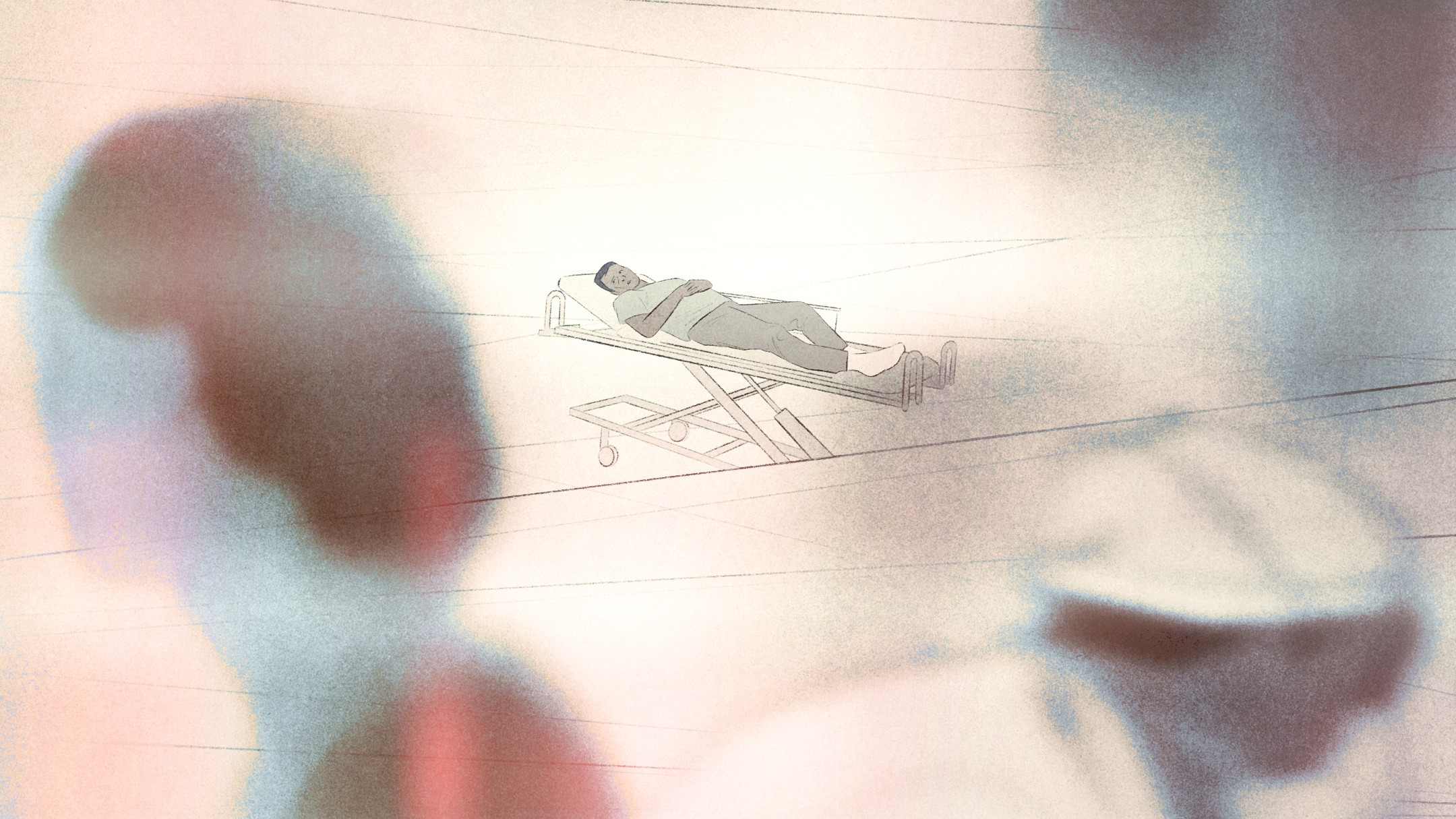
“I will not go to the emergency room”—emphasis on not—were his first words after passing out, having a seizure, or regurgitating the protein smoothies I made to pass his narrowed esophagus. He said it again and again, even as fluid built up in his lungs, rendering him short of breath and prone to agonizing coughing spells. He had been a big, athletic guy, but now, in the ugly process of dying, he was looking gaunt. Ours was a precarious existence, but I understood his adamant rejection of the emergency department. Most prior visits had morphed into extended trips into a terrifying medical underworld—to a purgatory known as emergency-department boarding.
I managed to keep Andrej at home while we planned for hospice, until one dreadful night at 2 a.m., when I ran out of hacks. We got into an ambulance and headed together to the hospital.
We had already learned the hard way that if you need admission to the hospital, you can remain in the emergency department—in the hallway or a curtained bay on a hard stretcher or in a makeshift holding area—for more than 24 hours, even for days, while waiting for a real hospital bed. In this limbo state, you’re technically admitted to the hospital but still located in the physical domain of the ER. And the rules governing acceptable care and safety measures become much less clear.
In the summer of 2024, still being treated to keep his cancer at bay, Andrej had suddenly become somewhat delirious, requiring hospital admission to rule out the possibility of infection or, worse, of the cancer having spread to his brain. After we went to an emergency department near our home, in New York City, he lay trapped on a hard stretcher, with its rails up, for more than 36 hours, amid the alarms and calls for the code team, without any clues of whether it was day or night, and with access only to the few toilets shared by the dozens of patients and visitors in the emergency room. None of this helped his mental state. By the end of day two, he knew me—kind of—but had become convinced that the doctors were “the enemy” and that I was their paid accomplice.
After I pressed to move him to a bed “upstairs”—I meant to an inpatient ward—he was transported to a bed five floors higher. I realized too late that this was an “ED overflow area,” according to the paper sign attached to the entrance’s swinging door. A plaque in the hall identified it as a former labor and delivery floor. It had been kitted out with some of the trappings of an actual ward, such as real beds and bathrooms, but not the most important one: adequate personnel.
The space was by turns eerily quiet and wildly cacophonous. Although patients there were undergoing intimate, embarrassing procedures, rooms were gender-neutral. That first night, Andrej’s roommates were a man in a coma and an elderly French woman in a diaper and boots (no pants), who marched around her bed singing like a chanteuse. In the morning, I pestered a harried nurse and got Andrej moved to a quieter room with three beds, where two people died in three days.
The overworked staff did the best they could, but that was far from good care. My husband—who needed protein and calories but could consume only soft foods—was served chicken cutlets. When I noted to one nurse that Andrej’s soiled sheets hadn’t been changed for several days, she directed me to a linen cart so I could change them myself.
That first time, one of several extended ER stays Andrej made as a boarder, I thought perhaps we had just hit a busy time at a busy hospital. When I worked as an emergency-medicine doctor a few decades ago, the ED was mostly empty at the beginning of my 7 a.m. shift. A few patients might be lingering from the day before: alcoholics who would sober up and leave, patients with a severe burn or a bad case of pneumonia who were waiting for a bed in intensive care.
In the decades since, EDs have doubled or even tripled in size. Even so, patients are piling up. When I started asking around, I quickly discovered that ED boarding has become commonplace in the past five or so years and is getting worse, more or less omnipresent in hospitals. “Everyone knows about this problem, and no one cares enough to do anything about it,” Adrian Haimovich, an ED doctor at Beth Israel Deaconess Medical Center who studies ED boarding, told me. “It’s barbaric.”
Measuring the problem has been challenging because data on ED-boarding time are limited. Only this past November did the Centers for Medicare and Medicaid Services finalize a rule that would require hospitals to collect data on ED-boarding times, starting in 2026. Using what other data he could find, Haimovich has shown that boarding for more than 24 hours has increased dramatically for people 65 and older since the coronavirus pandemic.
Once they enter ED boarding, patients exist in a gray zone. There has been a national push to establish “safe staffing” nurse-to-patient ratios in EDs. Even with that, if an ED boarder has a medical complaint that needs quick attention, it’s easy for them to fall through the cracks, Haimovich said: In some hospitals, an admitting team of doctors from upstairs is responsible for the boarders stuck in the ED (but not the associated floor nurses); in others, overstretched ED medical staff must take full responsibility to care for boarders until a bed opens—and that in addition to seeing new patients. Some EDs now routinely hold more boarders—many of them quite ill—than patients being actively evaluated.
Doctors and nurses have complained bitterly about the situation, which forces them to provide inadequate care. Gabe Kelen, the director of emergency medicine at Johns Hopkins University, told me that it’s creating a moral hazard for emergency-department staff. But doctors and department heads such as Kelen are not in control of admissions. Generally, a hospital’s administration parcels out inpatient beds, and emergency-department boarding is in many ways a result of today’s business models and pressures.
When I worked as a doctor, if an ED was overwhelmed beyond capacity, the attending (that was me) typically called in to ambulance dispatch to request “diversion”—ambulances should take patients to another hospital. If a hospital got too full, the admitting office canceled elective admissions. Today, hospitals run like airlines and intentionally overbook, Kelen said. They also have fewer beds than they did a few years ago—in part because nurse (and executive) salaries have risen since the pandemic. An empty, staffed bed is a money loser, so the institution has an incentive to keep beds full and make new patients wait.
“The problem isn’t inefficiency—it’s the way health-care finance is structured,” Kelen said. “Hospitals typically run on thin margins. Elective admissions are prioritized because they tend to be for lucrative procedures like heart catheterizations and joint replacements.”
Admitting patients through the emergency room has business advantages too, even if it means that patients wait for a bed. The evaluation generates charges that typically run many thousands of dollars; once admitted, my husband was still billed the inpatient rate even for a stretcher in the hall. Old, sick, and dying patients are more likely to linger there in part because, after they’re in a real bed, they may take up that spot for days or weeks at a time while waiting for a bed in rehab or hospice, requiring nursing time but not the types of interventions that generate revenue.
Hospitals have tried Band-Aid fixes, such as bed-tracking software and discharge lounges where patients can wait for paperwork or transport home. Many do hire more doctors and nurses and orderlies in the ER to confront the overflow. “Long ED wait times and boarding have root causes that extend far beyond EDs and hospitals themselves,” Chris DeRienzo, the chief physician executive at the American Hospital Association, told me in an email. He listed the high cost of opening beds and the shortage of rehabilitation facilities, and emphasized the precarious financial situation of many hospitals.
But while Andrej waited in the overflow area, we were not thinking of any bigger picture: He was sick, desperate, and still waiting for care. He lingered in boarding for four days before he got a bed. Each time he had to return to the ED, each time he faced a painful wait, he hardened his resolve to never go back.
Thunk. Crash. “Elisabeth, help!” Those were the sounds that woke me at 2 a.m.
I had fallen asleep in our bed, next to Andrej, his head raised with a foam wedge to ease his breathing and make sure food would not come up. Before I dozed off, I listened to his breathing—30 times a minute, two times faster than normal—a sign that he was struggling to get sufficient oxygen. And that racking cough. This was not good.
Now his bruised body was twisted, lying on the floor with his head against the bed frame. He’d attempted to use his walker to go to the bathroom. He was complaining of chest pain, coughing and short of breath. But he managed to get out those words: “I will not go to the ER.”
I knelt by his side in tears, telling him that I loved him but that I could not do anything more right now at home. Carlos, our super, helped me get him into bed and called EMS. I promised Andrej (against hope) that, given his condition, he would surely be quickly assigned to a real room and bed.
What happened next was a blur. I have a vague memory of paramedics arriving, putting him on the stretcher, sliding him into the ambulance, giving him oxygen. I mechanically grabbed his “do not resuscitate” form from under the refrigerator magnet and buckled myself in beside him.
Then he was in the ED, which was thrumming with activity, under the fluorescent lights, with oxygen in his nose, wearing a hospital gown, looking gray and sick. The staff asked what was, for them, the operative question about a guy with widespread cancer: “Does he have a DNR?” Andrej asked me what was, for him, the operative question: “Did you bring my shoes?” He already wanted to leave.
An X-ray showed possible pneumonia, more tumors, and a buildup of fluid in his lungs. A medical team that covers oncology patients wrote an admitting note—he was now a boarder, again—and then retreated upstairs. They started antibiotics and gave him something to help him sleep amid the alarms and shouting. He didn’t.
When I came back the next morning—and two mornings after that—I was alarmed to see him still there on a hard stretcher, his feet dangling off the end, exhausted and in pain. “When will he be admitted to a bed?’’ I implored. If some of the stuff in his lungs was infectious, maybe he could be treated and get home.
Likely soon and I hear your frustration—I came to detest those two phrases.
Neighboring patients came and went 24 hours a day. Some were pleasant; some were screaming in pain or just screaming mad. Pulmonary doctors came and, in this semipublic space, used a large needle to remove three liters of fluid from Andrej’s right lung cavity.
Near the end of the Biden administration, in response to a bipartisan congressional request, the Department of Health and Human Services convened a meeting on emergency-department boarding. Its report, from HHS’s Agency for Healthcare Research and Quality, came out the same month that the Trump administration took office, not long before Andrej’s fall—the last night he spent at home.
“Emergency department (ED) boarding is a public health crisis in the United States,” the report concluded. “Patients who are sick enough to require inpatient care can wait in the ED for hours, days, or even weeks … Boarding contributes to increased mortality, medical errors, prolonged hospital stays, and greater dissatisfaction with care.”
The meeting proposal called for the formation of an expert panel to recommend solutions. In theory, a panel could have weighed in on key questions: Should hospitals—some of which are rich institutions—get paid an inpatient rate for boarding in the ED? Should they have to report boarding times and face penalties for excess? Should they be required to open more real beds, and should requirements for licensing be lessened? How can the country create more rehabilitation beds?
But since then, the Trump administration has dramatically cut that HHS agency’s staffing, as well as its grant programs. (Congress is still pushing to fund the agency.) The expert panel never formed, let alone offered solutions. The Centers for Medicare and Medicaid Services did initiate a program this year that will include voluntary reporting of boarding times in 2027, which will become mandatory in 2028. Bad marks will eventually affect Medicare reimbursement.
In an emailed statement, the Joint Commission, which certifies the nation’s hospitals, called boarding a “serious public health crisis” and “one of the most incredibly complex challenges in healthcare.” Although the organization does indirectly look at hospitals’ “ED throughput” from charts, such data are not comprehensive. Little information exists, for instance, about how many people’s last days are spent on stretchers, in hospital limbo.
None of this knowledge would have helped my dying husband. So I did what I’d promised myself I’d never do: I called a doctor friend, who called the hospital’s VIP office.
Suddenly Andrej was whisked to a real hospital room, with a bed that he could adjust to keep his head elevated, a tray he could eat from, a morphine pump, a TV, a bathroom, and a nurse call button at his side. A room with extra chairs, so his stepkids and friends could visit with gifts and mementos one last time. A room where the caring staff placed a chaise longue, where I could sleep over. That way, when he woke scared and coughing and yelling for me, I was there to hold his hand, adjust the oxygen, and push the button for an extra dose of narcotic.
Until, six days after we got in the ambulance and three days after we’d moved to this room, he woke early one morning, agitated and coughing, calling out, “Elisabeth?” I was there. But then, in a blink, he wasn’t.