
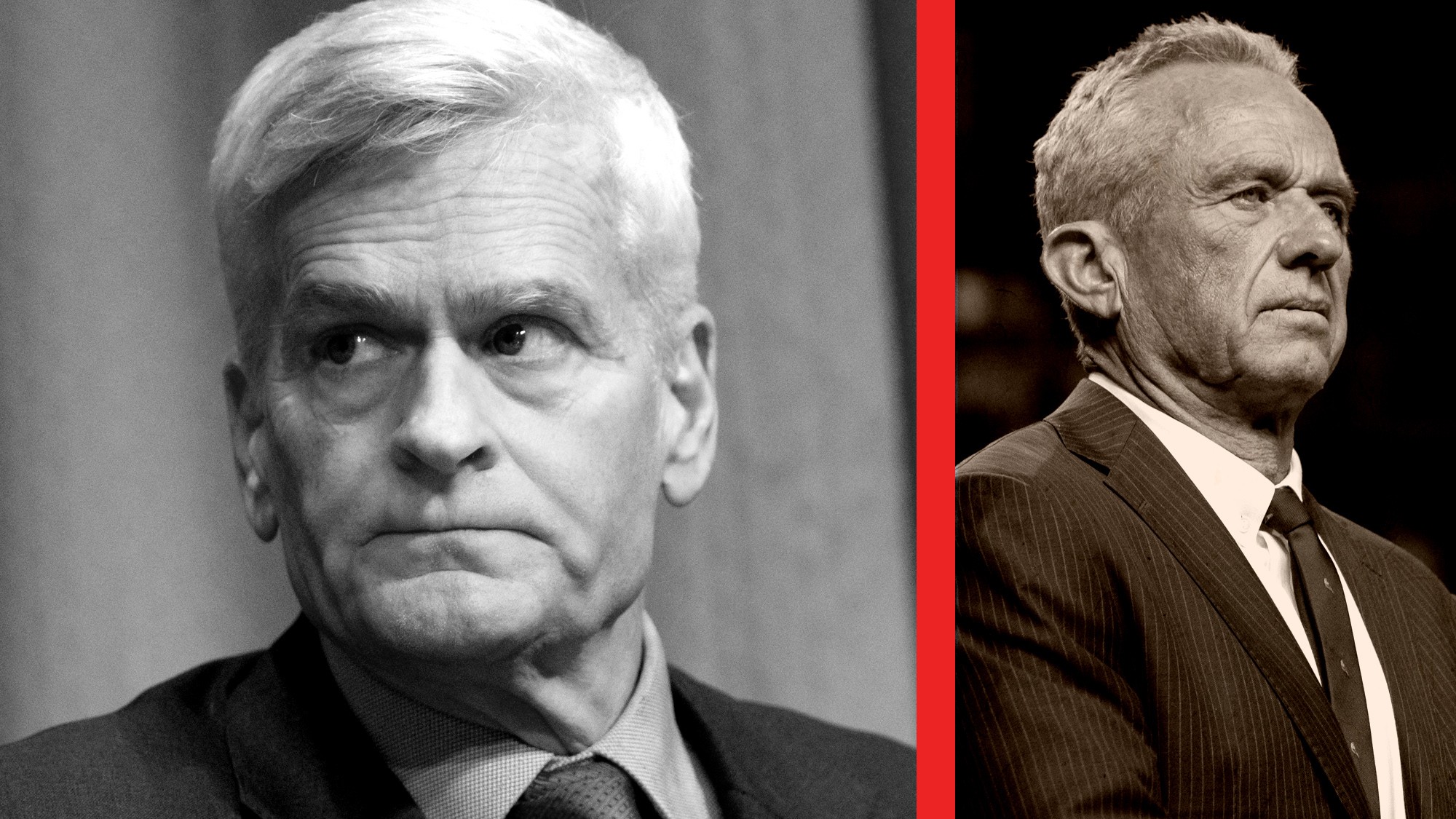
Bill Cassidy did not want to talk about Robert F. Kennedy Jr. Last month, as we shuffled through the U.S. Senate subway, a subterranean corridor connecting lawmakers’ offices to the Capitol, the senator from Louisiana was fielding rapid-fire questions from reporters about two of his favorite topics: drug pricing and college sports. But I asked him about his least favorite: Did he regret confirming Kennedy as health secretary?
I was eager to know because, in spite of that decision, Cassidy may be looking at the end of his political career. This weekend, after 11 years in the Senate, he is headed into a Republican primary election with polls trending out of his favor. His vote last year to hand the keys of America’s immunization policy to one of America’s most prominent vaccine skeptics now hangs over him as a political move that may not have been enough to save his life in politics.
Cassidy—who was one of the few Republicans to initially balk at confirming Kennedy—is pro-vaccine. As a liver specialist in a crowded Baton Rouge charity hospital at the turn of the new millennium, he saw firsthand the effects of hepatitis B, a vaccine-preventable disease; he later set up a school-based program in Baton Rouge that inoculated tens of thousands of children against the virus. At Kennedy’s confirmation hearing, Cassidy justified his vote by claiming that Kennedy could help restore faith in the medical establishment. It was, by all apparent measures, a vote against his values, an attempted olive branch to the new administration.
Cassidy has since criticized some of Kennedy’s actions as secretary, namely his decision to stack the CDC’s vaccine advisory committee with vaccine skeptics. Cassidy was also among a group of Republican senators who declined to publicly endorse the surgeon-general nominee Casey Means—a Kennedy ally and wellness guru. (Trump announced a new candidate for the job late last month.) But Cassidy refuses to acknowledge that he made a mistake by confirming Kennedy. In the months since the vote, his staff has repeatedly declined my requests for a sit-down interview. In the Senate subway that day, he sidestepped. “I’m a doctor. You make a decision, you move on,” he told me. “You don’t sit around and say, ‘Oh my gosh, that was a great decision. Oh my gosh, that was a bad decision.’ No, you just move on.”
In Louisiana, being anti-Kennedy means being anti-Trump. And the problem for Cassidy is that many of his constituents already see him as both.
Cassidy’s career in government has been predicated on the claim that he has approached politics as a doctor first. One of his earliest campaign ads for Senate, in 2014, featured him in scrubs and a white coat decrying the Affordable Care Act, which he said would give politicians power over Louisianans’ health care. Once elected, he established himself as the health-policy wonk of the Republican caucus. Cassidy’s efforts to replace the Affordable Care Act failed, but since then, he has ushered major health-care reforms through Congress, including laws targeting surprise medical bills and fentanyl trafficking. A Louisiana medical school and several centers for health education and research have recently gotten multimillion-dollar makeovers thanks to Cassidy, and he has taken credit for tucking more than $200 million in funding for the state’s rural health care into the tax bill Republicans passed last July.
Cassidy remains well liked among major Republican donors, as evidenced by the fact that he has far outpaced his competitors in fundraising. But Louisiana voters are shunning him. In February 2021, he was one of seven Republican senators who voted to convict Trump of inciting the January 6 insurrection. The Republican Party of Louisiana censured him, and one of the state’s most prominent conservative-talk-radio hosts dubbed him “Psycho Bill.” Five years later, a subset of Republican voters still talk about him as if he had set fire to the French Quarter. At an event for one of Cassidy’s challengers, John Fleming, I met Linda Verzwyvelt, a former real-estate agent from Lafourche Parish. Verzwyvelt was eager to strike up a conversation with me, offering me snacks and introducing me to her neighbors. But when the topic turned to her sitting senator, her demeanor shifted. “I want to just strangle him,” Verzwyvelt told me.
[Read: MAHA swing voters are an illusion]
Cassidy’s challengers have sought to foment that anger, framing themselves as more loyal to Trump. “I just think he’s ineligible to serve again because of what he did,” Fleming told the crowd at his event. He touted his own service in the first Trump administration, during which he rose to be an adviser to the president. In her campaign-launch video, Julia Letlow, a current House representative for Louisiana and Trump’s pick for Cassidy’s Senate seat, includes a montage of photos of herself alongside the president. She declares, “A state as conservative as ours—we shouldn’t have to wonder how our senator will vote when the pressure is on.”
Many of the state’s Republican activists, including members of powerful GOP women’s clubs and local Republican Party offices, have abandoned Cassidy. When I spoke with a group of women outside of the monthly luncheon for the Republican Women’s Club of Jefferson Parish, only one told me she was definitely voting for Cassidy. Another, Linda Doyle, told me that the first time she ever knocked doors for a campaign was to get Cassidy elected, but now she can’t trust him because of the Trump vote. I heard something similar from Jacques Migues, an attorney from Iberia Parish who serves on the area’s Republican Executive Committee. Cassidy “can’t be a trusted member of the team,” he told me. The women’s club has not officially endorsed a candidate, but the Iberia committee has endorsed Letlow.
With the primary less than a week away, Cassidy has a real risk of losing: A recent survey from Emerson College found him in third place. Trump has recently attacked Cassidy, blaming him for preventing Means’s confirmation. Kennedy and his allies appear out for revenge too. “Bill Cassidy once again did the dirty work for entrenched interests seeking to stall the MAHA movement and protect the very status quo that has made America the sickest nation on earth,” Kennedy wrote on X after Means’s nomination was pulled. MAHA Action, the political arm of Kennedy’s “Make America Healthy Again” movement, has pledged $1 million to unseat Cassidy.
Cassidy is anti-abortion, pro-gun, and tough on immigration. He is further left than some of his party, but he certainly isn’t liberal, and he hasn’t changed much since he was elected to the Senate in 2014. Instead, Louisiana has. Cassidy’s predecessor in the Senate was a Democrat, Mary Landrieu, who had served for nearly 20 years. Over Cassidy’s tenure, the number of registered Republicans in the state has grown by 30 percent. Now Republican voters want a lawmaker who reflects their MAGA views, not a moderate.
That includes their views on vaccines. Ever since COVID shots became available, Louisiana’s uptake has been among the lowest in the country; as of January, only 10 percent of Louisiana adults had received a 2025–26 booster. When Louisiana attempted to require COVID vaccinations for schoolchildren in 2021, Kennedy, then the chair of the anti-vaccine advocacy group Children’s Health Defense, came to the legislature to oppose the move, calling the shot the “deadliest vaccine ever made.” The mandate was never implemented. (HHS declined to comment for this story.)
[Read: The states are going full RFK Jr.]
The specter of COVID has faded, but many Louisianans remain fixated on the idea that mandating public-health measures, such as vaccines, infringes on their freedom. In 2022, roughly three dozen anti-vaccine bills were introduced in the state legislature. Last year, Ralph Abraham—then Louisiana’s surgeon general—banned the health department from promoting seasonal vaccines or conducting mass-vaccination drives. When I visited the state capital in April, three committees were simultaneously considering vaccine-related bills. One would outlaw monetary incentives for doctors to administer vaccines; one would lift the school requirement for immunization against meningitis; and one would ban Louisiana organizations and businesses from denying services to the unvaccinated.
These actions come as Kennedy pushes to cement vaccine skepticism into national policy. In addition to stacking the CDC’s vaccine advisory panel with skeptics, he has pledged to rework the government system that tracks suspected vaccine injuries, and has used the CDC’s website to cast doubt on the scientific consensus that vaccines do not cause autism—all of which, according to Cassidy, Kennedy promised not to do during the confirmation process. According to The New York Times, Kennedy is currently overseeing a CDC inquiry into whether, as he believes, immunization can be linked to chronic diseases including autism.
[Read: Bill Cassidy’s failure on vaccines]
Most of the bills in Louisiana haven’t become law, and a judge has invalidated many of HHS’s most dramatic anti-vaccine actions. But the focus on the purported harms of vaccines—in Washington and Baton Rouge alike—has raised suspicion toward immunizations, according to multiple Louisiana doctors I spoke with. When Mikki Bouquet, a pediatrician in Baton Rouge who also serves on the board of Louisiana Families for Vaccines, was starting out in medicine, parents refusing to vaccinate their newborns against hepatitis B, for instance, were rare. “Now it’s like every day I have one, maybe two moms out of 10 babies that are not for it, and they won’t even have a conversation,” Bouquet told me.
Many Louisianans still see benefits to vaccination. A recent poll sponsored by Louisiana Families for Vaccines found that 80 percent of voters in the state still support school vaccine mandates. When I caught up with Bouquet, she had just finished testifying against a bill that would lift the school requirement for meningitis immunization and was being swarmed by a group of students who thanked her for her testimony. But in recent years, vaccination rates have been dropping across the state. As of 2024, just 44 percent of children 2 and under in Concordia Parish, which had the lowest vaccination rate in the state, were fully up-to-date on their shots. The Washington Post recently reported that not a single parish in Louisiana has kindergarten vaccination rates high enough to reach herd immunity against measles, mumps, and rubella.
In late 2024 and early 2025, Louisiana was hit with another vaccine-preventable disease: whooping cough. The outbreak was the worst in three decades; two infants died. In September, Cassidy asked Kennedy to call for parents in the state to get their kids immunized. But Kennedy gave no public response.
The Louisiana Senate race isn’t primarily about vaccines, or about Kennedy. But Cassidy’s tumultuous relationship with the health secretary provides Trump with yet another way he can attack the senator, whom he once called a “disloyal lightweight.” Kennedy’s supporters seem happy to contribute to the senator’s demise. Cassidy does, after all, have some power to be a check on Kennedy’s agenda, as evidenced by his role in canceling Means’s nomination. And while he won’t acknowledge any regret about confirming Kennedy, he has contradicted some of Kennedy’s claims. When I asked him during our brief hallway interview last month about Kennedy’s impact on efforts to vaccinate American children, Cassidy told me that the “confusion” and “mixed messages” around vaccines “has certainly not been helpful.”
The result is that Cassidy has developed a reputation as the rabidly pro-vaccine candidate that parents should fear. When I spoke to Charles Owen, who represents Vernon Parish in the Louisiana House, he claimed that Cassidy supported going door to door checking people’s vaccination status. Working against “health freedom” in that way, he told me, is a losing issue in Louisiana.
But Cassidy’s record suggests he would not be in favor of that sort of policy. He vocally backed a plan in the Senate to block COVID mandates during the Biden administration. Both of his competitors toe a similar line. “I’m not against vaccines, but I am for informed consent and against mandates,” Fleming, who is also a medical doctor, told me. After Letlow’s husband died of COVID in late 2020, she urged Americans to get their shots, calling herself “a huge proponent of the vaccine.” And she has fully vaccinated her own children, according to Abraham, the state’s former surgeon general who is now Letlow’s campaign chair. In a statement, Letlow’s campaign also told me, “Congresswoman Letlow believes vaccines should be a personal decision made between individuals, parents, and their trusted medical providers. She does not support government vaccine mandates and never has.”
[Read: The Trump administration is trying to have its vaccine policy both ways]
At the time of Kennedy’s confirmation, Cassidy openly struggled in making his decision. “If there’s any false note, any undermining of a mama’s trust in vaccines, another person will die from a vaccine-preventable disease,” Cassidy told Kennedy during the hearing. The senator’s public waffling provided evidence to his constituents that he was only reluctantly a member of the president’s team. “The way that he held out, that was pathetic,” Lisa Neal, a self-described health-freedom advocate, told me at the Fleming meet and greet.
Most Louisiana voters are not as vehemently against public-health mandates as Neal, but many are angry at Cassidy for the same reason: In the age of Trump, there are no half-gestures of loyalty. You’re MAGA or you’re not. Cassidy traded his legacy for an attempted show of loyalty by voting in Kennedy. But it seems to not have even registered with many voters in his state.